

Montana registered agent search finds the party that accepts legal papers for a business, and that party sits inside the entity record rather than in a separate index. A commercial service handles many companies, while a noncommercial agent is normally someone inside the business, such as an owner or a member of staff. The field carries a name and a Montana street address, and both are public.
This page covers the lookup, the two kinds of agent the state recognizes, the address rule that decides whether an appointment works, the change and resignation routes, service of process, and the limits of what the public file shows. It is written for an owner choosing an agent and for a reader who received a notice and wants to know who was served.
How to Find a Montana Registered Agent
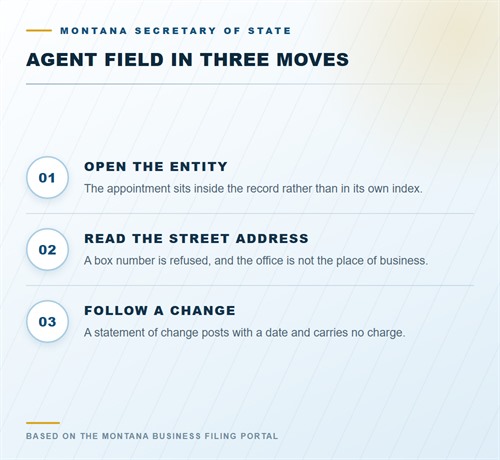
Open the entity record first, because the appointment belongs to the company rather than to the person. A reader can reach that record with a business name or an entity number, and the agent block sits below the name and the condition. The wider index opens from Montana registered agent search on the front page, while the agent-name route answers a different question.
By Business Name
Type the distinctive word and open the row whose class and town match the business. The agent block is one of several on the page, and it names a party plus a street address. A company that changed its agent during the year may still appear under the older name on a letter, while the portal shows the current appointment.
By Entity Number
The number reaches one file and skips the name question. It appears on the formation certificate, on a notice about the report, and on a receipt from an earlier order, and a rename never moves it. A reader who has a state paper to hand should copy the digits from it before typing.
By Agent Name
An agent-name search is the route a process server uses, and it returns every company that party serves. A commercial agent can appear on hundreds of files, so the list needs a second filter by town or class. A noncommercial agent usually appears on one or two. Two companies with one agent and one street address are often related, though the file does not say how.
What the Agent Field Shows
The block carries the agent name and a street address inside Montana. It does not carry a telephone number, an email address, or a fee. The field is a service address rather than a general contact point, and the office does not publish the agent’s own contact details. A reader should copy both parts exactly. The pair is what makes service work.
Name and Capacity
The name may be a person or a company, and the capacity matters. A commercial service is registered to do the work, while an individual accepts it as a duty. A reader who is checking a contract should confirm that the party named is the one that agreed, because the state file records the appointment rather than the agreement behind it.
Street Address Rule
The address must be a physical location in Montana where a paper can be handed over. A post office box is refused in this field, and a mailbox store can be refused when it does not accept service. A home address works when the owner accepts delivery there, and that choice puts the address on the public file.
Commercial and Noncommercial Agents
Montana recognizes both kinds, and the difference is who accepts the role rather than what the role does. A commercial agent offers the service to the public and appears on many records. A noncommercial agent is connected to the company and takes the duty without selling it. An owner who picks a commercial service buys continuity, because the service stays in place when the owner moves.
Commercial Agents
A commercial service keeps a staffed office and a process for accepting papers during business hours. The service usually reminds the client about the annual report, because a lost notice is the failure that ends most registrations. A reader who checks a commercial agent should confirm that the office is open and that the address is current.
Noncommercial Agents
A noncommercial agent must be a Montana resident or an entity with a street address in the state, depending on the class. The appointment is signed, and a filing without the signature is returned. A founder who acts as the agent should expect the home address to appear on the public file.
Changing or Resigning
A company can change its agent, its office, or both, and the statement of change carries no charge. The new party accepts the role, and the office posts the change with a date. A reader who sees a new agent mid-year should expect the next notice to reach the new party rather than the old one. A resignation follows a different route.
Filing the Change
The statement names the company, the old appointment, and the new one. A change of address alone uses the same form, and a change of agent alone uses it as well. The filing is free, which makes an outdated address hard to justify.
Resignation
A resignation is filed by the agent rather than by the company, and it carries a charge. The paper names the company and the effective date. A company that receives a copy should appoint a replacement at once, because the file can be marked after the resignation takes effect. A gap between the resignation and the replacement is the window in which a claim can go unanswered.
Service of Process
Service is the delivery of a legal paper to the party that agreed to accept it. The agent receives the paper, and the company is treated as having notice. A reader who is checking whether service was proper should confirm that the paper went to the address on the file on the date it was delivered.
What Counts as Delivery
The rule follows the statute rather than the address alone, and a reader who needs the exact standard should read the section that applies to the class. In practice, the paper must reach the party at the street address on the record.
After Service
A company that receives a paper should note the date and the party that signed for it. The note becomes part of the response file, and it is what a lawyer asks for first. A company that ignores the paper because the address was stale has a harder problem than the claim itself.
Agent Records and Privacy
The agent field is public, and the address on it is visible to anyone who opens the record. An owner who uses a home address should expect it to appear in a search engine as well as on the portal. A commercial service exists partly to keep that address off the file.
The Agent’s Own File
The office does not publish an agent’s telephone number or email, and it does not list the agent’s other clients. A reader who needs the agent’s own standing can open the agent’s entity record when the agent is a company. The Montana business records page sets out the papers that sit behind that file.
Checking a Commercial Agent
A commercial agent is a business, and its own file shows whether it is current. A service that has lost its registration is a risk to every company it represents, because a notice can go unanswered. A reader should also confirm the street address on the service file, since a move that was never filed leaves clients exposed. The Montana business status page shows how to read that condition.
What the File Does Not Show
The file does not show the agreement between the agent and the company, the fee the agent charges, or the length of the appointment. It does not show whether the agent has ever missed a paper. Those facts come from the parties rather than from the register.
Agent Addresses and Mail Handling
An agent address is a delivery point rather than a post office. The party named must be able to accept a paper during a business day, and the address must be a place where a person can appear. A rented mailbox that does not sign for documents fails that test even when it looks like an office.
Mail That Is Not Legal Service
The agent receives legal papers, and ordinary mail usually goes to the business address instead. A notice about the annual report may reach either address, which is why both should be current. A reader who is sending a routine letter should use the company address rather than the agent.
Agent Duties Through the Year
The role is quiet for most of the year and critical in a few moments. A company should treat the appointment as part of its annual paperwork rather than as a line on the formation form. The agent accepts a paper when one arrives, and the company handles everything else. A company should confirm the appointment once a year, at the same time as the report.
Reminders and the Report
The office sends the report notice to the agent on the file. A service that forwards the notice gives the company a second chance, while a stale address gives none. A reader who has missed a report should check the agent field before blaming the mail.
When a Notice Goes to the Wrong Place
A paper delivered to an address the company no longer uses can still count as service when the file was never updated. The company then learns about the claim late, and the response window may already be running. That sequence is the practical reason a change of address is filed rather than remembered.
Repairing the File
A statement of change repairs the address and the agent at the same time, and it carries no charge. A company that files it promptly closes the gap that a later paper could use. A reader who is drafting a response should ask for the filing confirmation as proof of the correction.
Choosing an Agent
An owner should decide three things before naming a party. The first is whether the address should be public. The second is whether the agent will be reachable during a business day. The third is whether the arrangement survives a move, a sale, or a change of ownership. A commercial service answers the first two and usually the third, at a cost.
Agent Fees
Nothing is charged for the search. The table below covers the filings that touch the appointment. Montana keeps the statement of change at no charge, which is unusual enough to be worth noting, while a resignation carries a fee.
| Agent item | Fee |
|---|---|
| Agent search | $0 |
| Statement of change, agent or office | $0 |
| Resignation of agent | $35 |
| Certificate of existence | $5 |
| Certificate of fact | $15 |
| Annual report, filed late | $35 |
| Certified copy of a filing | $10 |
Frequently Asked Questions
Each question below comes from an owner choosing an agent or a reader who received a paper.
Is the agent search free?
Yes. The record opens without a profile, and the appointment is part of it. No charge is attached to reading the field.
Can the owner act as the agent?
Yes, when the owner meets the residency or address rule for the class. The appointment puts that address on the public file.
Does a change of agent cost anything?
No. The statement of change carries no charge, and the office posts it with a date. A resignation is different and carries a fee.
What happens if the agent resigns?
The company has a window to appoint a replacement. A file without an agent can miss a notice, so the replacement should be filed at once.
Is the agent the owner of the business?
No. The role is about accepting papers, not about holding an interest. A commercial agent usually has no financial stake at all.
Where is the agent address shown?
It sits in the record below the name and the condition, and it appears on a certificate of existence as well. The address must be a Montana street address.