

Montana business status search answers the question a counterparty asks first: does this registration still hold? The business portal prints the current condition beside every result, and the record shows how that condition came about. A word such as active, inactive, delinquent, or dissolved changes the weight of every other field on the page, from the agent to the document list.
This page reads the standing rather than the search box: what each value means, which events move a company from one value to another, why a buyer or a lender cares, how a closed file returns, and the papers that prove the condition to a third party. It is written for a reader who already has a record open and needs to interpret it.
How to Check a Montana Business Status
The condition appears near the top of an entity page, beside the class and the formation date. A reader can reach that page with a name or with an entity number, and the two routes land on the same blocks. A screen shows the present; a certificate fixes a day. The lookup is free and begins at Montana business status search on the front page.
By Name
A name query returns rows with the condition beside each one, so a reader can screen several companies before opening a file. A shared word produces a long list, and the town is often what separates two firms that chose the same name. Open the row whose class and address match the business in front of you.
By Entity Number
The number lands on one file and removes the ambiguity of a name. It appears on a certificate, a report notice, and an older receipt, and a rename does not move it. A reader holding any state paper should read the digits off it before typing. Compare the digits with the paper first, then try the agent route if the number cannot be confirmed.
Reading the Label
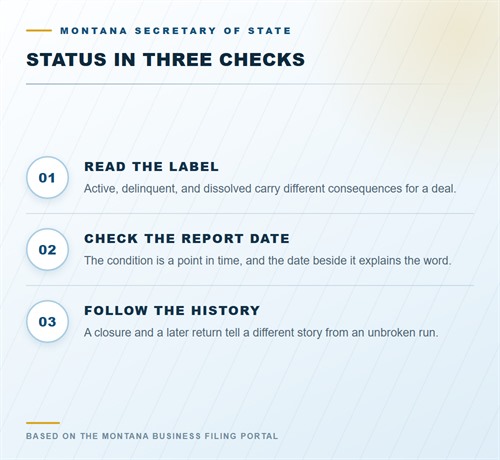
The condition is one word, and the last report date sits near it. Read the pair together. A company that reported in the current cycle reads differently from one that has been silent for two years, even when the words look alike.
What Each Standing Means
Montana publishes a short list of condition words, and each one carries a different consequence. The word appears on the result grid, on the file, and on a certificate of existence, so a reader who quotes it should also quote the date it was read. The word describes compliance rather than quality.
Active
An active company has sent the report for the current cycle and holds a registration in force. The word says the paperwork is current and says nothing about revenue or reputation. A supplier that reads as active can still be a poor credit risk, and a buyer who needs the rest of the picture asks for accounts and references.
Inactive
An inactive file remains on the register after the reports stop or after the office notes a change. The business may still trade, yet the state file no longer supports a claim of compliance. A reader who meets this word should ask for the last report receipt before treating the company as current.
Delinquent
A delinquent flag appears when a report is late, and it can sit beside an otherwise open file. The flag is the office’s note that the compliance paper has not arrived. It is the value behind many refusals from a bank, a landlord, or a licensing board.
Dissolved or Revoked
An owners’ dissolution ends the registration by choice, while a revocation follows a failure to file and comes from the office. The labels differ, and so do the dates, and the word a reader quotes in a file note should match the entry. Assets and debts survive either ending even when the record stops vouching for the business.
Standings Across Entity Classes
The same word can mean slightly different things by class, because the paper behind it differs. A limited liability company reports under one section, a corporation under another, and a nonprofit under a third. A reader who compares two labels should confirm that the two files sit in the same class. A cooperative and a business trust carry their own schedules.
Limited Liability Companies
An LLC that stops reporting can be flagged and later dissolved, and the file keeps the closure date. A reinstatement adds a charge for each year that was missed. A reader who needs the class detail can follow the Montana LLC records page, which carries the same fields with the company-specific rules.
Corporations
A profit charter and an exempt charter both report yearly, and both can be revoked. The profit reinstatement starts at a higher amount than the exempt one, while the yearly addition is the same. A reader who sees a revoked corporate file should check which class the charter belongs to before quoting a remedy. The Montana corporation records page sets out both charters and their separate amounts.
What Changes a Standing
A condition moves when a paper arrives or when a deadline passes. The report is the usual trigger, and an amendment or a closure can move it as well. A reader who wants to know why a file reads a certain way should look at the document list and the dates rather than at the word alone.
The Annual Report
A report sent by April 15 keeps the file current and costs nothing. A late report carries a fee, and a long silence can end the registration. The office does not chase a new address unless the agent field is up to date, which makes the address on the file as important as the date.
Amendments and Agent Changes
An amendment does not move the condition by itself, but it can repair the address that a notice depends on. A change of agent is free and takes effect when the office posts it. A reader who sees a new accepting party mid-year should expect the next notice to reach that party rather than the old one.
Closure
A voluntary closure is a deliberate act, and the file shows the day the paper was accepted. A reader who finds one should compare that day with the contract date, because an obligation may predate the end of the company. Creditors can still pursue a closed company for those obligations.
Why Standing Matters in a Deal
A bank, a landlord, or a buyer reads the condition before anything else, because it decides whether the remaining papers are worth the effort. A contract with a closed company can be hard to enforce, and a payment to one can be hard to recover. The check takes a minute and prevents a dispute that takes months. The condition is a starting point rather than a conclusion.
Before a Contract
Check the condition on the day of signing rather than the day of negotiation. A file can move between those dates, and a printout carries the day it was made. Save the printout with the agreement so a later reader can see what the register said at the time.
Before a Payment
A check before a first payment is the cheapest fraud control available. Confirm that the legal name on the invoice matches the record, that the condition is active, and that the address matches the agent or the office. A mismatch is not proof of fraud, but it is a reason to ask for a paper that ties the trading name to the entity.
Restoring Standing
A company that lost its registration can return through a reinstatement, and the path depends on the class. The form names the company and the reports that were missed, and the office restores the file once the balance is settled. The history then carries two dates, the closure and the return, which is what a lender reads. The practical cost is the interruption rather than the amount.
By Class
A limited liability company pays a filing amount plus a charge for each delinquent report. A profit corporation pays a different starting amount with the same yearly addition, and a nonprofit pays less at the start. The yearly figure is what grows with a long gap, so a company returning after several years pays more than one returning after a season.
After the Return
Once the approval posts, the word turns active and the next report keeps the usual date. Order a certificate after the record updates, and send the copy to whoever raised the question. Keep the earlier closure notice beside it, because the pair makes the gap legible in a way a single paper cannot.
Proving Standing to a Third Party
A screen answers a question for the reader, but a bank, a landlord, or a registry usually wants paper with a seal. The office issues a certificate of existence for that purpose, and it states the condition on the day of issue. A certified copy of a filed paper serves a different need, because it reproduces text rather than a status.
What the Certificate States
The paper carries the entity name, the number, the class, and the condition as of its issue date. It does not list owners, revenue, or licences, and it does not promise that the company will stay active. A reader who needs those facts has to ask the company or another office.
What It Does Not Prove
The certificate does not prove that a company pays its tax, holds a permit, or owns its equipment. Those facts sit with the Department of Revenue, the licensing board, and the county. A reader who treats the paper as a clearance can sign with a firm that owes money or lacks a credential.
A Standing Note for a File
A reader who checks a company should write three things: the entity number, the word that appeared, and the day of the lookup. The note takes a minute and answers a question months later without a second search. A photograph of the screen is less useful than the note, because a picture carries no explanation.
What a Standing Check Misses
The register reports filings and condition, and it stops there. It does not carry a lawsuit, a lien, a tax balance, or a customer complaint. A reader who needs the whole picture has to add those searches to the file rather than infer them from a word. A clean word is a statement about paperwork, not about conduct. The word is one field among several.
Status Fees
The search is free, and the amounts below cover the papers that prove a condition or restore a file. Montana keeps these items in the same published schedule as the formation filings, so a reader can plan a remedy in one pass.
| Status item | Fee |
|---|---|
| Standing check | $0 |
| Certificate of existence | $5 |
| Certificate of fact | $15 |
| Certified copy of a filing | $10 |
| Late annual report | $35 |
| Reinstatement, limited liability company | $35 plus $35 per delinquent year |
| Reinstatement, profit corporation | $30 plus $35 per delinquent year |
| Reinstatement, nonprofit corporation | $10 plus $35 per delinquent year |
Frequently Asked Questions
The questions below come from readers who have a record open and need to read the condition correctly.
Is a standing check free?
Yes. The portal shows the condition without a charge or a login. Money is owed only when a paper is ordered or a filing is sent.
What does inactive mean on a Montana record?
The registration remains but the reports have stopped or the office has noted a change. Treat the file as unproven until a current receipt appears.
Can a dissolved company still trade?
It can keep operating in practice, but the official record stops backing the paperwork. A reinstatement restores the registration, and the closure stays on the file beside the return.
Does an active label mean the business is safe to pay?
No. It means the reports are current. Credit, licensing, and tax standing sit outside the register and need their own checks.
How long does a certificate of existence last?
The paper states one day, and each recipient sets its own age limit. Order close to the date of use rather than months ahead.
Where does a reinstatement start?
It starts from the record or the forms page, and the amount depends on the class and the number of years that were missed. A reader should confirm the class before sending a paper.