

Montana business records search is the lookup a reader runs when a register summary is not enough and the paper trail has to be read. The business portal holds the formation papers, the amendments, the reports, and the closing papers for every entity, and it shows that index before a single copy is bought. A reader can see what exists without paying for anything.
This page covers the file itself: the papers a buyer usually orders, the difference between a plain copy and a certified one, the certificate that states a fact rather than a condition, the files of a closed company, the material the office never receives, and the charges attached to each request. It is written for a buyer building a diligence folder and for an owner replacing a lost paper.
How to Search Montana Business Records
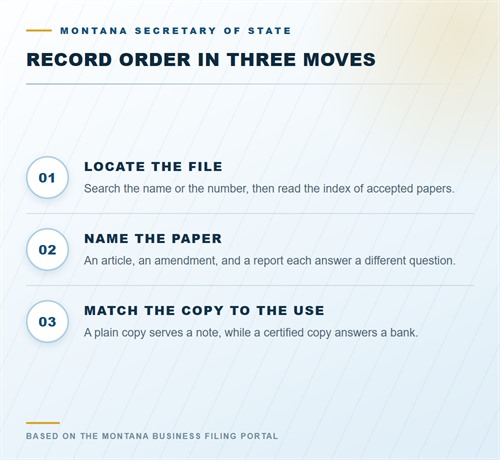
One field starts the lookup, and it takes either the legal name or the entity number. The number is the shorter route when a certificate is at hand, because it lands on the file with no list in between. A reader who has only the trading name should begin with the name and narrow the result by class. The request begins at Montana business records search on the front page.
Finding the File
Type the distinctive part of the name and leave the designation off. A grid follows, with the class and the town beside each row. A company that renamed itself may appear under the current string, while an older paper still carries the former one. Where the name is uncertain, the number settles it.
Reading the Index
The record page carries an index of accepted papers, each with a type and a date. It is a catalogue rather than a library, so a reader can confirm that an amendment exists before deciding to buy it. The index also shows which items can be downloaded and which need a request. A reader who needs the condition rather than the text can follow the Montana business status page.
Choosing the Paper
Each question points to one or two documents. A reader who needs to know whether the company exists wants a certificate of existence. A reader who needs the exact clause that created it wants a copy of the articles. A reader who needs the date a name changed wants the amendment. A reader who is unsure should read the index first and order second.
What the File Holds
A business file is a stack of papers rather than a narrative. It states what the company submitted, the day each paper was accepted, and the addresses the company declared. It does not carry revenue, customers, employees, or reputation. The file answers a small set of questions well: whether the company is on the register, who accepts service, and what has been filed.
The Formation Paper
The articles that created the company carry the original name, the accepting party, the address, and the filing date. A reader who wants the precise words of a clause buys the copy rather than trusting a summary. The formation paper is also what a foreign registry usually asks for beside a certificate.
Changes and Reports
An amendment records what changed and when the office took it in. A report confirms the agent and the addresses for a cycle, and it is the paper that sets the condition for that year. The two belong in one folder, because one answers what changed and the other answers whether the file stayed current.
The Closing Paper
A termination, a dissolution, or a withdrawal ends the registration, and the paper carries the day the office accepted it. A reader who needs to know when a company stopped filing should read that day rather than the last report date. A revoked file may show a different paper again, because the office closed it rather than the owners.
Copies and Certificates
Three products leave the same office, and each answers a different question. A plain copy gives the reader the text. A certified copy gives the text plus a stamp that a counterparty can verify. A certificate of existence gives neither text nor history, only a statement about the file on a given day. A reader who buys the wrong product pays twice.
Plain Copies
A plain copy serves an internal note, a call with the company, or a working paper in a review. It carries the text and the filing date, and it can be downloaded or posted. It is the cheaper route when the reader is the only audience.
Certified Copies
A certified copy carries a stamp that the text matches the record, and that stamp is what a court or a bank accepts. The request names the paper and its filing date so the clerk can locate it. A certified copy of an amendment is the usual answer when a name changed during a transaction.
Certificates of Existence and Fact
A certificate of existence states that the entity is on the register and reports its condition on the issue date. A certificate of fact states a narrower point, such as a filing date or a document on the file, and it fills a gap the standing paper leaves. A reader should match the paper to the question rather than order the heavier document by habit.
Reading Dates and Gaps
The history is a timeline, and the timeline is what a buyer reads to see how the company has been run. A rename, a move, and a new agent appear in the order the office processed them. A quiet stretch proves nothing by itself, because a posted paper can arrive weeks after it was signed.
Late Postings
A gap between two reports can mean a late filing, a lost notice, or a company that stopped and returned. The office posts the day it accepts a paper rather than the day it was signed, so a December signature can appear as a January entry. A reader who compares the acknowledgment with the posting date avoids a false conclusion.
Names and Numbers Across the Years
The number stays put through a rename, while the name on the older papers does not. A reader who quotes a name from an old document should check the live entry before using it in a contract. The history is what links the two strings.
Closed Files
A closed company keeps its file, and the name stays in the index with an end date beside it. The papers are not erased, so a search years later still returns the record and its timeline. That persistence helps a buyer and complicates a founder who wants the same name.
Two Kinds of Closure
An owners’ dissolution and an office revocation carry different labels and different dates. A reader who needs to know which one happened should read the entry rather than the condition word alone. A revoked file can often be restored, and the history will show the break.
A Retired Name That Returns
A retired name can come back on a new file with a new number, and the two entries then sit in the same list. The older one keeps its end date, while the newer one carries the live condition. A reader who finds two entries with one name should compare the dates before assuming a mistake.
Records Held Elsewhere
The business file does not carry a tax account, a licence, a lien, or a lawsuit. Those records sit with the revenue office, the licensing board, the county clerk, and the court. A reader who needs them requests them from the office that holds them. A tidy business file beside an unpaid tax bill is a familiar pairing in a diligence review.
Tax and Licence Files
A sales or withholding account sits with the state revenue office, and a trade credential sits with the licensing body that grants it. A city or county permit sits with the local government. None of those appear on the business file, so an active company can still lack a required account or permit.
Liens and Court Papers
A lien sits with the county clerk or with the office that records it, and a lawsuit sits with the court. A reader who needs the litigation history asks the clerk for the case index rather than the business register. The two searches answer different questions and belong side by side in a folder. The accepting party behind the address has its own Montana registered agent page.
Requesting a Document
An order moves through the portal or by mail. The electronic route delivers a file and keeps a receipt in the account, while the mailed route brings paper after travel time at either end. A request that names the number and the exact paper moves without a follow-up question. A reader who needs a paper for a closing should order before the closing week.
What the Request Should Carry
The request carries the entity number, the paper type, and the filing date where it is known. A short cover note saves a round of questions, and a return address saves a second request. A reader who orders several papers should list each one on its own line.
Checking the Delivery
A receipt shows the day the order was placed, and it is the reference for a missing item. A reader who has not received a document after the stated window should quote the receipt rather than describe the order from memory. A replacement can usually be sent once the order is located.
Access and Retention
The register is open because the statutes require it, and the portal serves the file without a login. A reader can look up any company and read the index without stating a reason. The openness is what makes a pre-payment check practical for a small buyer. A folder with both is stronger than a folder with either one alone.
What a Reader May Copy
A public paper can be copied for personal or business use, and a certified copy carries the office’s stamp. A reader who republishes a document should check the terms that apply to the state’s material. A copy used in a court filing usually has to be certified, and a download rarely satisfies that rule.
What Stays Private
A member list, a shareholder ledger, and a home address that the record omits stay outside the public file. A reader who asks the office for them is asking for a paper the office never received. Those documents come from the company, and the office declines to confirm a fact it cannot see.
Building a Diligence Folder
A folder that answers a later question without a second search has four parts. The first is the register printout with the day of the lookup on it. The second is the formation paper. The third is the latest report, and the fourth is a certificate of existence dated for the transaction. An amendment joins the set whenever a name or an address moved during the review.
Record Fees
The lookup is free, and the amounts below cover the papers and the faster service a reader can buy. Montana publishes one schedule for these items, and the copies sit beside the certificates so a reader can compare them in one view.
| Record item | Fee |
|---|---|
| Record lookup | $0 |
| Certified copy request | $10 |
| Certificate of existence | $5 |
| Certificate of fact | $15 |
| Bulk data, per record | $0.02 |
| Business alert, one year | $50 |
| Facsimile copy | $5 |
| Same-day 24-hour service | $20 |
| One-hour service | $100 |
Frequently Asked Questions
The questions below come from buyers, owners, and researchers who need a document rather than a summary.
Are Montana business records public?
Yes. The file is open to anyone, and the lookup carries no charge. A reader can open a record without stating a reason, which is what makes a check before a payment practical. A charge applies to a copy, a certificate, or a faster service.
What is the difference between a copy and a certified copy?
A copy carries the text, while a certified copy adds a stamp that the text matches the record. A bank or a court usually asks for the certified version, because the stamp is the part a counterparty reads.
Can I get a document from a closed company?
Yes. The file stays on the register after a closure, and the papers remain available. The timeline shows when the office closed it.
Does the file include tax or licence records?
No. Those sit with the revenue office, the licensing board, and the local government. The business file covers filings and condition only.
How long does an order take?
A routine request waits its turn, and a paid lane exists for a date that cannot move. A mailed request adds travel time at either end, and the receipt shows which route was bought.
Can I order a document without the entity number?
Yes, but the request is slower. A name can match several files, while the number points to one, so the clerk has to confirm the match before pulling the paper.