

Montana LLC search opens the file that the Secretary of State keeps for a limited liability company, and that file is where a buyer, a lender, or a member confirms what the company has actually filed. One query on the business portal returns the company name, the entity number, the class, the standing, the registered agent, and a list of documents with dates. The record is public, and reading it costs nothing.
This page follows the limited liability company from its articles to its termination: the search routes, the fields on the record, the series option, the members and managers the office does not publish, the yearly report, the route back from delinquency, the amendments that change the file, and the closing papers. It is written for an owner checking a filing and for a reader checking an owner.
How to Search Montana LLC Records
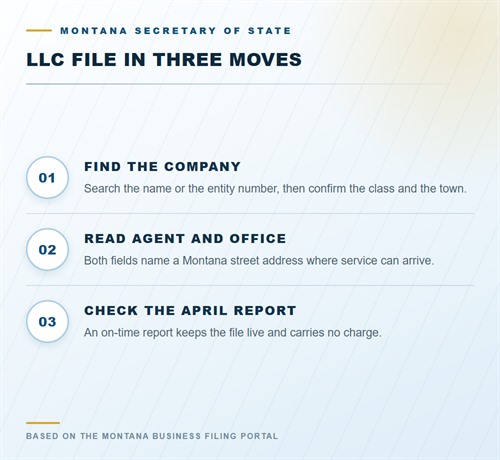
The portal accepts a company name or an entity number, and either route opens the same record. A reader who knows the business but not the number should start with the name and narrow the list by type. The wider register opens from Montana LLC search on the front page, and a certificate holder can skip the comparison.
Search by Company Name
Type the distinctive word and leave Limited Liability Company, L. L. C. , or LLC off on the first pass. A query built on an invented term returns a short list, while a query built on a place name can return dozens of rows. The city beside each result helps separate two companies that picked the same word in different towns.
Search by Entity Number
The number is issued with the accepted articles and remains attached to the file for as long as the record exists. It can be read from the formation certificate, a report notice, or a certificate of existence. A rename does not move it, so a reader can follow the file through every change of name. A reader who needs the corporate equivalent can follow the Montana corporation records page.
Comparing Similar Results
Sort the list by standing and then by the formation date, because a live company with a recent filing is usually the one trading today. A dissolved record with a familiar name often belongs to an earlier attempt at the same business. The city, the agent, and the number separate the two. A long list rewards a pencil.
What an LLC Record Shows
An LLC file is a filing record rather than a business profile. It reports the legal name, the class, the number, the standing, the dates attached to each paper, and the addresses the company declared. It does not report revenue, employees, customers, or credit history. The file also shows the office’s own marks, such as a delinquent flag or the date a reinstatement posted.
Identity and Standing
The name, the number, and the class identify the file, and the standing says whether the registration holds. A company that has filed its report reads as active, while one that has let the report slide can be marked delinquent and later dissolved. The standing is a point in time, so a printout from last month may describe a condition that has already moved.
Registered Agent and Office
Service of a claim requires a street address in Montana and a party who agrees to accept it. A box number is refused in both fields. The accepting party may be a commercial service that handles many companies or an individual inside the business. The address for service and the place of business are separate fields, and they frequently diverge.
Document List
The list runs from the articles through every amendment and report, with a merger or a termination at the end where one exists. Each line gives a paper type and a posting date. A reader who needs the exact wording of a paper orders a copy rather than relying on the list. The Montana business records page covers the copies a buyer can order from the same list.
Forming a Montana LLC
The articles of organization create the company, and the office assigns the entity number when it accepts the paper. The organizer supplies the name, the registered agent, a Montana street address, and a mailing address. The company exists from the filing date, not from the date the document was signed. The articles then take less than an hour, and the tax registrations follow in the days after.
Articles of Organization
The form asks for the company name with an accepted ending, the registered agent and office, the principal address, and the signature of the organizer. Montana does not require a purpose clause on the standard form, which keeps the document short. A professional company adds the statement its governing statute requires.
The Series Option
A series LLC can name each series member in the articles, and each member adds to the formation charge. The series structure keeps the records of one cell apart from another, which matters to an investor who wants a ring around a single project. A reader who sees a series company should confirm which member the contract names, because the series is not always the entity that signed.
Filing Route
The articles reach the office either through the online portal or by post to Helena. An electronic filing returns a confirmation that stays in the account, while a posted one comes back as paper. A refusal comes with a reason and no refund, so the name and the signature deserve a check first.
Members, Managers, and the Agreement
Montana does not publish a member list for an LLC, and the public file does not identify the owners. The articles name the agent and the office, and the annual report confirms the address, but neither paper exposes a membership schedule. A buyer who needs the ownership picture has to ask the company.
What the Office Publishes
The public record shows the name, the number, the standing, the addresses, and the document list. It does not show capital contributions, percentages, or manager titles unless a later amendment restates them. A person-name search can return the file when that person is the registered agent, which is a role rather than an ownership interest.
Manager-Managed and Member-Managed
Both models file the same articles, and the difference lives in the agreement rather than in the register. A manager-managed company gives day-to-day authority to a named manager, while a member-managed company leaves it with the members. A contract that names an officer should be checked against the agreement, because the state file does not list the title.
Records a Lender Asks For
A lender that finances an LLC usually wants three papers: the articles, the operating agreement, and a certificate of existence with a recent date. The state file supplies the first and the third, while the company supplies the agreement. A member who signs a guarantee should add that paper to the same folder, because the lender will call on it first if a payment is missed.
The Annual Report
An LLC reports once a year, and the deadline is April 15. The report confirms the registered agent, the office, and the mailing address, and it keeps the company on the active list. A report filed by the deadline carries no charge, and a report filed after it carries one. A filer should treat the report as a check on the address rather than as a formality.
Deadline and Window
The window opens at the start of the year and closes on April 15. A report filed early leaves the rest of the year free of the question, while one filed at the last minute risks a queue. The portal keeps the confirmation, and that confirmation is the proof of the filing date.
What It Confirms
The report restates the agent, the office, and the mailing address. It does not restate the members, and it does not ask for a financial figure. A reader who expects the report to reveal ownership will not find it there, because the office collects the addresses rather than the cap table. A reader who needs the ownership split should put the request to the company in writing.
After the Deadline
A report that arrives after April 15 carries a charge rather than a rejection. A long lapse can lead to delinquency and then to dissolution, and each year of missed reports adds to a reinstatement bill. The office does not send a second notice to a new address unless the agent field is current.
Losing Standing and Returning
A skipped report can lead to a delinquent mark, and a longer gap lets the office end the registration. The file then carries a closure date, and the company’s agreements become harder to enforce. Property and debts survive the closure even though the record no longer vouches for the business. A company that never returned reads differently from one that recovered.
Reinstatement
The file then carries the closure and the return as two dates, and a lender can read the interruption without a call.
Application for Reviver
Montana also publishes an application for reviver, a separate form used to revive a company whose registration has ended. A reader should confirm which route applies before sending a paper, because the two forms carry different charges and different effects on the record. A call to the office costs nothing and prevents a second filing.
After the Return
Once the company is back, the standing reads active and the next report falls due on the usual date. A fresh certificate of existence ordered after the return reports the restored condition. A buyer should keep that certificate beside the earlier one, because the pair shows the interruption in the file.
Amendments and Closure
An LLC changes its record through an amendment, a restatement, or a correction, and each one is a separate form. A name change and a purpose change run through an amendment. A restatement replaces the articles in one document, while a correction fixes a typing error without changing the decision behind it.
Amendment and Restatement
An amendment states the article that changes and the new wording, and the office posts it with a date. A restatement replaces the whole document, which is useful when several articles have changed over the years. Neither form changes the entity number, so a reader who follows the number arrives at the current version.
Termination
A company closes through articles of termination, and the filing states that the affairs have been wound up. The record then shows a terminated standing, and the company stops reporting. A company that closes without settling its tax accounts may still hear from the Department of Revenue, because the two offices do not share the closure.
LLC Fees
The lookup carries no charge, and the amounts below cover the filings and papers an LLC is most likely to order. Montana publishes one schedule, and the annual report sits at the top of it because the charge depends on the filing date. A reader who plans a closing should add the certificate to the same budget.
| LLC item | Fee |
|---|---|
| Articles of organization | $35 |
| Series member, each one named | $50 |
| Annual report by April 15 | $0 |
| Annual report after April 15 | $35 |
| Articles of amendment | $15 |
| Restated articles of organization | $15 |
| Articles of correction | $15 |
| Reinstatement | $35 plus $35 per delinquent year |
| Application for reviver | $15 |
| Articles of termination | $0 |
| Certificate of existence | $5 |
| Statement of change, agent or office | $0 |
Frequently Asked Questions
The questions below come from members, buyers, and lenders working with a Montana LLC file.
Is the Montana LLC search free?
Yes. The portal charges nothing for a lookup and needs no account. Money is owed only when a filing is sent or a document is ordered.
Does Montana publish the members of an LLC?
No. The public file shows the agent and the addresses, not the membership schedule. Ownership comes from the operating agreement or from the company directly.
How much does the annual report cost?
A report filed by April 15 carries no charge. A report filed after the deadline carries a charge, and each missed year adds to a later reinstatement.
What happens when an LLC is dissolved?
The office can dissolve a company that stops reporting, and the record shows the closure. A reinstatement or a reviver can restore the file, and the history keeps both dates.
Can a series LLC name several members?
Yes. Each series member is named in the articles, and each one adds to the formation charge. A reader should confirm which member a contract names.
Does the record show a manager?
Not usually. The state file carries the agent rather than the management structure, so the operating agreement is the document that names a manager.