

Montana corporation search opens the record that the Secretary of State keeps for a profit corporation, a nonprofit, or a business trust, and that record is the one a bank, a buyer, or an officer reads first. The business portal returns the corporate name, the entity number, the class, the standing, the agent, and every accepted paper. The lookup is free and needs no profile.
This page covers the corporate side of the register: the classes the office files, the articles that create each one, the directors and shares the public record does or does not show, the annual report, the route back from a lapse, the papers that merge or close a company, and the charges that apply. It is written for officers confirming a filing and for readers checking a charter.
How to Search Montana Corporation Records
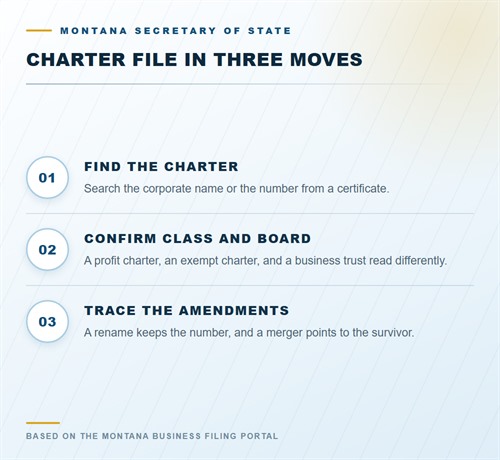
The portal offers one query box, and it accepts either the corporate name or the entity number. A reader who has a certificate should use the number, because it opens the file directly. A reader who has only the trading name should start from that name, then filter by class. The wider index is open from Montana corporation search on the front page.
Search by Corporate Name
Type the distinctive term and set the corporate ending aside on the first attempt. A place name pulls a mixed list, which helps when the reader does not yet know the class. The town shown against each hit, together with the class, shortens the list at once. Where the first attempt returns nothing, try the earlier name. A query on the agent name is the other practical route.
Search by Entity Number
The office assigns it on acceptance, and it stays put through every rename. Copy it from the formation paper or from a standing certificate, because a directory can print an old figure. A typo in the number returns an empty page, and an empty page is easy to read as a company that never filed.
Reading the Result Grid
Each row carries the name, the number, the class, the city, and the standing. A long list usually means the search word was broad rather than that the company owns affiliates. Sort by standing, then by the formation date, and open the entry that matches the address or the agent on your paper.
What a Corporate Record Shows
A corporate file is a set of charter papers rather than a business profile. It states what the corporation filed, when the office accepted each paper, and which addresses and agents the corporation declared. It does not list customers, revenue, litigation, or credit history. A reader who needs the standing read as a condition rather than a filing list can follow the Montana business status page.
Class and Charter
Montana files profit corporations, nonprofit corporations, and business trusts, and each class has its own articles. A profit charter authorizes shares, while a nonprofit charter states a purpose and issues none. A business trust files under its own heading and follows a different statute. The class decides the annual report form, the reinstatement amount, and the papers that can be filed later.
Directors and Officers
The articles name the initial directors, and later filings can restate the board. The public record does not carry a full officer list, and it does not show a shareholder ledger. A contract signed by an officer should be checked against the company’s own minutes, because the state file will not confirm the title.
Registered Agent and Office
The charter names a Montana street address for service and a party who accepts it. A post office box is refused in both fields. The principal office, where the company works, is a separate field, and the two addresses often differ. A paper delivered to the wrong one can leave the board unaware of a claim.
Forming a Corporation
The charter comes into being when the office accepts the articles, and the number is assigned at that moment. The organizer enters the corporate name, the accepting party, the street address, and the first directors. A founder should clear the name before writing the articles, because a refusal costs a filing. The agent and the address come next, and the share decision comes last.
Articles of Incorporation, Profit
The profit form asks for the corporate name with an accepted ending, the agent and office, the principal address, the authorized shares, and the names of the initial directors. The incorporator signs, and the company exists from the filing date. A share count that is too low can force an amendment before a financing, and the amendment carries its own charge and its own delay.
Articles of Incorporation, Nonprofit
The exempt form asks for a purpose clause, a dissolution clause, and a statement about members. It does not ask for shares, and the charge is lower than the profit filing. The purpose and the dissolution wording carry into a later federal application, so both deserve care at the start.
Business Trusts
A business trust files its own articles under a separate chapter, and the charge is higher than either corporate form. The document names the trustees and the address for service. A reader who meets a trust in a contract should search the trust name rather than a corporate ending.
Directors, Shares, and the Corporate Book
The state file holds the charter, the amendments, and the reports. The bylaws, the minutes, and the stock ledger stay with the corporation, and a buyer who needs them has to ask during diligence. The office cannot certify a paper it never received. A small corporation often has one person in every role, and the record shows that person as incorporator and director.
Authorized and Issued Shares
The articles state the shares the corporation may issue, not the shares it has issued. A reader who needs the issued count should ask the company for the ledger. An increase to the authorized count requires an amendment, and that amendment appears in the public list.
What the Public File Omits
The file does not name the shareholders, and it does not show the price paid for a share. It does not carry a buy-sell agreement or a voting trust. A reader who treats the charter as a cap table will overstate what the record proves. The limited liability company version of these fields has its own Montana LLC records page.
The Annual Report
A Montana charter must send one report each year by April 15. The form restates the accepting party and the addresses, which is how the office keeps the charter live. An on-time report is free of charge, and a late one is not. The report is a compliance paper rather than a financial statement.
Deadline and Filing Window
Filing opens in January and shuts on April 15. Send it early and the remaining months need no attention; send it at the end and it joins the queue at the counter.
What the Report Confirms
The report restates the registered agent, the street address, and the mailing address. A corporation that moved or replaced its agent during the year should correct both fields at that moment. A notice sent to an old address reaches nobody, and the office does not forward it.
Losing Standing and Reinstatement
A corporation that skips its report can be marked delinquent, and a longer lapse lets the office revoke the charter. A closure date then appears on the entry, and enforcing the company’s agreements becomes harder. The business can still own property and carry debt while the file no longer proves compliance. A reader who finds a revoked charter should look for a reinstatement in the history.
Reinstatement, Profit and Nonprofit
The profit reinstatement carries a filing charge plus an amount for each delinquent report, while the nonprofit version carries a smaller filing charge and the same yearly amount. The office restores the charter when the balance clears. The record then shows the closure and the return as separate entries.
After the Charter Returns
After approval the label turns active again, and the following report keeps the usual date.
Amendments, Mergers, and Dissolution
A charter changes through an amendment or a restatement, and both leave the earlier paper in the list. A merger combines two companies and ends all but the survivor. A dissolution closes the charter, and a revocation of dissolution can undo that closure if it was filed in error. Each filing has a different effect on the file.
Amendment and Restatement
The amendment names the article that changes and the new wording, and it posts with a date. A restatement replaces the whole document in one filing. The identifier is untouched by either form, so following the digits leads to the latest text.
Merger and Succession
A merger leaves a survivor whose file carries the combined charter, and the absorbed companies show an end date with a note pointing to the survivor. A contract signed before the merger binds the survivor, which is why a buyer traces the chain rather than reading one record.
Dissolution and Revocation
Articles of dissolution close the charter and carry no charge. A revocation of dissolution undoes a closure filed in error, and the office charges a small amount for it. A reader who sees both entries should read the dates in order before describing the company as closed.
Foreign Corporations
A company chartered elsewhere registers here before it transacts business in the state. The foreign registration statement names the home jurisdiction, the Montana agent, and the local address. The office issues a certificate of authority when the papers clear, and the company then reports on the Montana schedule. The home charter remains the source of the company’s existence, and the Montana file answers only the local authority.
Registration and Withdrawal
A foreign profit corporation pays a higher registration charge than a foreign nonprofit, and a business trust pays its own amount. A withdrawal ends the local authority without dissolving the home company. A reader who finds a withdrawal should follow the home registry for the current standing.
Ordering Corporate Paper
A reader who needs the charter in evidence has two routes. The first is a certificate of existence, which states that the company is on file and reports its standing on the day of issue. The second is a certified copy, which reproduces a paper the office already holds and stamps it as a true copy. A buyer can order online or by mail.
Corporate Fees
Nothing is charged for the search. The table lists the corporate amounts a filer or a buyer is most likely to need. The state uses one published schedule for these items, and the reinstatement lines add a yearly amount for every report that was missed.
| Corporate item | Fee |
|---|---|
| Articles of incorporation, profit | $35 |
| Articles of incorporation, nonprofit | $20 |
| Articles of incorporation, business trust | $70 |
| Articles of amendment | $15 |
| Restated articles | $15 |
| Articles of merger | $20 |
| Articles of dissolution | $0 |
| Reinstatement, profit | $30 plus $35 per delinquent year |
| Reinstatement, nonprofit | $10 plus $35 per delinquent year |
| Annual report, filed by the deadline | $0 |
| Annual report, filed late | $35 |
| Certificate of existence | $5 |
| Foreign registration, profit | $70 |
| Certificate of authority, foreign nonprofit | $15 |
Frequently Asked Questions
The questions below come from officers, buyers, and attorneys who work with a Montana charter.
Is the Montana corporation search free?
Yes. No profile is needed, and the state adds no fee to a lookup. A charge belongs to a filing or to an ordered paper.
Does the record show the shareholders?
No. The charter shows the authorized shares rather than the issued ones, and the shareholder ledger stays with the company.
What is the difference between the profit and nonprofit filings?
The profit form authorizes shares and costs more, while the exempt form carries a purpose clause and no shares. The annual report and the reinstatement amount differ as well.
Can a revoked charter be restored?
Yes. A reinstatement restores the registration when the missed reports are paid, and the file shows the closure beside the restoration.
Does a foreign corporation report every year?
Yes. A registered foreign corporation follows the Montana schedule and keeps a Montana agent while the authority lasts.
Where does a certificate of existence come from?
The office issues it on request for a small charge, and it states the standing on the day of issue rather than the history. A reader should order it close to the date it is needed.