

Montana business name search is the check a founder runs before paying for a filing and the check a buyer runs before trusting a brand. The business portal searches the same index that holds every entity and every assumed business name on file, so a query shows what is already taken. A name that clears the index is not protected by that clearance, but a name that fails it will not be accepted on a formation document.
This page covers the search, the comparison the office applies, the reservation that holds a cleared word, the assumed business name that lets a company trade under a brand, the trademark question the state cannot answer, and the charges attached to each filing. It is written for a founder choosing a name and for a business adding a second brand.
How to Search Montana Business Names
The portal takes a word or a phrase and returns every entry that carries it. Start with the term that gives the business its identity rather than with the full legal string, because the list is what exposes a near twin. The index itself opens from Montana business name search on the front page, while the rules below decide the result.
Search the Distinctive Word
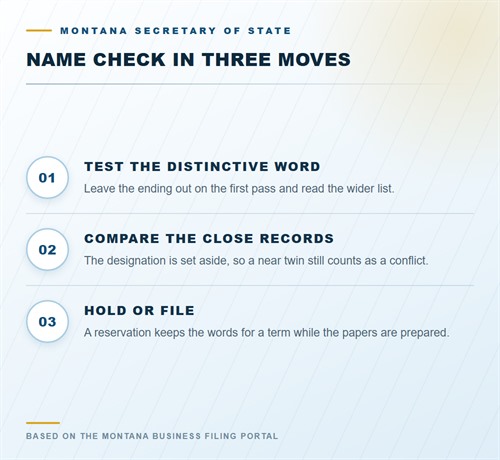
Type the word that carries the identity and leave the designation out on the first attempt. An invented word narrows the field, while a town name can fill a page with rows from several classes. The class and the city beside each result narrow it. The list is more useful than a single hit, because it shows how the index treats similar wording.
Check the Assumed Name Index
An assumed business name is filed separately, and it can sit in the index without a formation document behind it. A company name that clears the entity list can still be in use as a brand by an existing business. Search both views, and read the registration that ties the brand to its owner.
Compare the Close Matches
A close result is a reason to look further rather than a final answer. Compare the distinctive words, the ending, and the class, then decide whether a customer would confuse the two businesses. A word that describes the trade adds little, so the distinctive term carries the decision in almost every review.
What a Name Entry Shows
A name entry is a filing record rather than a marketing profile. It carries the legal name, the class, the entity number, the standing, and the dates attached to each paper. It does not show revenue, customers, or reputation. The entry answers two questions first: whether a name is taken and which entity holds it.
Legal Name and Brand
The legal name is the one printed on the formation paper, and it holds the main line in the index. An assumed business name sits in its own registration and names the owner behind the brand. A reader who searches a storefront should look in that index as well, because the brand may not appear as the legal name of any entity.
Former Names
A company that changes its legal name files an amendment, and the earlier string stays in the history. A query on the old name may return the current record with a note about the change, or it may return a line that points to the new entry.
The Rules That Decide a Name
A proposed name is accepted when it is distinguishable from the records already on file and it follows the requirement for its class. The office applies the comparison when it reviews the document, and a name that cleared last month can fail if another filing landed in between. Availability is a snapshot, which is why a reservation exists.
Distinguishability
Two names conflict when a reasonable person would treat them as the same business. The designation is set aside in the comparison, so a company and a corporation built on the same distinctive words can still collide. A descriptive term such as supply or services carries little weight, which leaves the distinctive word to decide the result.
Required Designation
A limited liability company must carry Limited Liability Company, L.L.C., or LLC. A corporation must carry a recognized ending such as Corporation or Incorporated. A nonprofit uses a corporate ending as well, and a limited partnership carries its own. A name that misses the designation is returned even when every other word is free.
Restricted Terms
A name that suggests a bank, an insurer, a trust company, or a government body can need a consent before the office accepts it. A professional practice adds a licensing condition, and the credential has to exist before the name can be used. A founder who wants a regulated word should ask before filing rather than after a refusal.
Name Reservation
A reservation holds a cleared name for a limited period while the formation papers are prepared. It is optional, and it is useful when a founder needs time for signatures or a lease. The reservation does not create an entity, and it does not protect the word from a federal trademark claim.
Filing the Request
The request names the proposed name, the class it is meant for, and the applicant. The office checks the index and issues a reservation when the name clears. The confirmation belongs with the formation papers, because the articles reference it.
Term and Transfer
A reservation runs for the term printed on the confirmation. A founder who lets it lapse may find the name taken, and the office will not hold it. A transfer or a cancellation of a reservation carries no charge, which makes a change of plan inexpensive.
Assumed Business Names
An assumed business name lets an existing company or a sole proprietor trade under a brand without forming a second entity. The registration records the owner, the brand, and the term, and it appears in the index beside the legal names. A business with several brands files a registration for each one. The filing is a disclosure rather than a grant of rights.
What the Registration Shows
The registration names the owner, the brand, and the address, and it prints a filing date. It does not show the ownership of the entity, and it does not show a trademark. A reader should read the owner field first, because the owner is what a customer or a court needs to trace.
Renewal
A registration runs for a term and expires unless it is renewed. A renewal is a short filing with its own charge, and the owner has to be current to file it. A lapsed registration leaves the brand unlinked in the index even when the business keeps using the name.
Names for an LLC and a Corporation
Both classes are checked against the same index, and the designation is set aside in the comparison. The distinctive word carries the weight, and the class field separates two entries that share it. A founder who plans to convert should choose a word that works for both forms. A nonprofit should match the name to the purpose in its articles, because the two are read together.
Professional and Regulated Names
A professional company provides a licensed service, and its name usually identifies the profession. The members must hold the credential, and the name cannot suggest a service they are not licensed to provide. The formation document adds a statement about the service.
Names That Suggest a Larger Business
A name that implies branches, offices, or a national operation can be refused when the company is a single small firm, because the wording would mislead a customer. The same test applies to a name that suggests a government connection. A founder who wants a broad word should be ready to show that the business actually works that way.
Names for a Nonprofit
A nonprofit uses a corporate ending and states a purpose in its articles, and the name is read together with that purpose. A name that suggests a private benefit can raise a question at the state desk and again at the federal desk. The safe choice names the mission plainly and avoids a word that promises a return to a founder.
What a Buyer Checks in a Brand
A buyer who reviews a business with several brands should list every assumed name, because each registration carries its own term. The list should note which are current and which have expired, since a sign says nothing about the filing. For the record behind the brand, follow the Montana LLC records page, and the Montana corporation records page for the corporate version.
Trademark Checks Beyond the Office
The state index is not a trademark register. A name that clears the office can still infringe a federal mark or an unregistered brand that another business has used in trade. A founder who plans to spend money on signage should run a federal search before the launch. A federal search is free and takes less time than a rejected application.
Unregistered Rights
A business that used a name without registering it can still hold rights in its area under unfair competition law. Those rights are local and fact dependent, and a state search will not reveal them. A founder who operates in a small area may accept that risk, while a business that plans to expand should take advice.
When a Name Is Refused
A refusal is not a permanent bar. The office returns the document with a reason, and the filer can change the name and resubmit. The resubmission is a new filing with a new charge, so every issue should be corrected at once. A consent from another owner can resolve a conflict when the two businesses are related.
Reading the Return Letter
A founder who reads the letter against the statute usually finds the fix in one pass. A similarity refusal needs a different distinctive word, while a designation refusal needs the right ending. A licensing refusal needs the credential, and a consent refusal needs a signed letter from the other owner.
Name Fees
The search costs nothing, and the amounts below cover the filings that hold or register a name. Montana keeps these charges in the same schedule as the entity filings, so a founder can plan the whole sequence in one place.
| Name item | Fee |
|---|---|
| Name search | $0 |
| Name reservation | $10 |
| Transfer or cancellation of a reservation | $0 |
| Assumed business name registration | $20 |
| Assumed business name renewal | $20 |
| Assumed business name amendment | $20 |
| Cancellation of an assumed name | $0 |
| Registration of a foreign name | $10 per year |
| Certificate of existence | $5 |
Frequently Asked Questions
The questions below come from founders, brand owners, and buyers who need to know whether a name is free.
Is a Montana name search free?
Yes. The index opens without a profile and charges nothing for a query. A charge applies to a reservation, a registration, or a formation.
Does a reservation guarantee approval?
No. It confirms the index on the day of the request. The articles still have to pass review, and another filing can land in between.
How long does an assumed business name last?
The registration runs for a set term and lapses without a renewal. A lapsed brand stays on a sign while the index no longer links it to the owner.
Can two businesses use the same word in different trades?
Sometimes. The index looks at confusion, and a different trade with a different customer can support the same word. A federal search is the next check.
Do I need a trademark to use a name?
No. A name can be used in trade without a registration. A trademark adds a stronger claim, and the federal system runs its own search and charges its own fee.
Can I reserve a name before forming a company?
Yes. A reservation holds the word while the papers are prepared, and a transfer or cancellation carries no charge if the plan changes.